Ordering custom golf gloves, whether it is a dozen for a member-guest team or a few hundred for a corporate outing, means getting three things right that have nothing to do with the logo. A golf glove is worn equipment that touches the club on every swing, so the material, the fit, and even which hand it goes on matter more to whether it gets used than any artwork you print on it. Sort those out first and the branding takes care of itself.
Which hand, and why people get it wrong
The single most common mistake in a group glove order is handedness. A golf glove is worn on the lead hand, the one at the top of the grip, because that hand does the most work holding the club and takes the most friction. For a right-handed golfer that means the glove goes on the left hand; for a left-handed golfer it goes on the right. Buyers who assume the glove matches their dominant hand order backwards constantly. When you are collecting a group order, ask each person’s playing hand explicitly rather than their dominant hand, and if you have to stock a general run, weight it heavily toward left-hand gloves, since right-handed golfers are the large majority.
Material sets the feel and the price
Three materials cover almost every glove, and they behave very differently. Cabretta leather, a fine sheepskin, is the premium choice: it is thin, breathable, and transmits the texture of the grip straight to your hand, which lets a player hold the club lighter. Its weaknesses are moisture and wear. Cabretta loses grip in the rain, can stiffen after a real soaking, and even with care a leather glove is often good for roughly 20 rounds before it goes slick or thin. Synthetic gloves flip those traits: they tolerate moisture without hardening, last longer with almost no maintenance, and cost less, but they sit on the hand rather than becoming part of it and tend to trap sweat in heat. Hybrid gloves put a leather palm on a synthetic back to deliver most of the leather feel, commonly described as around 90 percent, while keeping much of the synthetic’s durability and weather tolerance.
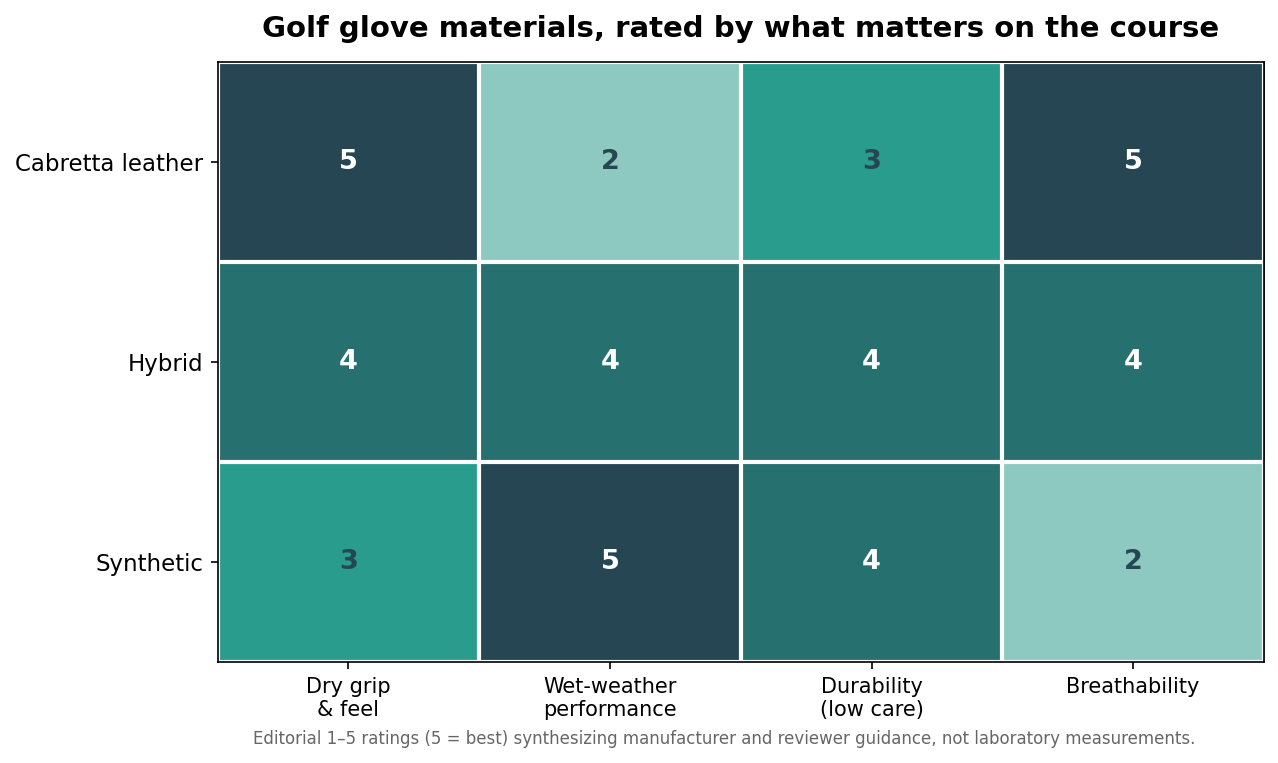
For a hot, dry climate or players who prize feel, Cabretta or a hybrid is worth it. For junior programs, high-turnover promotional gloves, or wet regions, synthetic is the practical pick, and it is also the material that takes full-surface printing best. Rain gloves are a separate synthetic category engineered to grip better as they get wet, and they are worth mentioning to any buyer who plays through weather.
Care extends the gap between materials. A leather glove that is air-dried flat after each round, kept out of direct heat and sun, and wiped down with a damp cloth will hold its grip far longer than one wadded into a bag pocket wet, which is how most gloves die early. It is worth passing that guidance along with a premium glove order, because a Cabretta glove treated well can approach the service life of a synthetic one, while a neglected one will not last half as long.
Fit is the difference between worn and abandoned
A golf glove should feel like a second skin. The leather or fabric across the palm should be taut with no loose pockets, the fingers should reach the tips without extra material bunching, and the closure should pull snug without straining. A glove that is even slightly too big slips at the moment of impact and gets left in the bag. Standard sizing runs from small through extra large, but there is a second axis many buyers miss: cadet sizing. Cadet gloves have shorter fingers and a wider palm and fit roughly one in five male golfers, the ones for whom a regular glove leaves empty fingertips or feels tight across the hand.
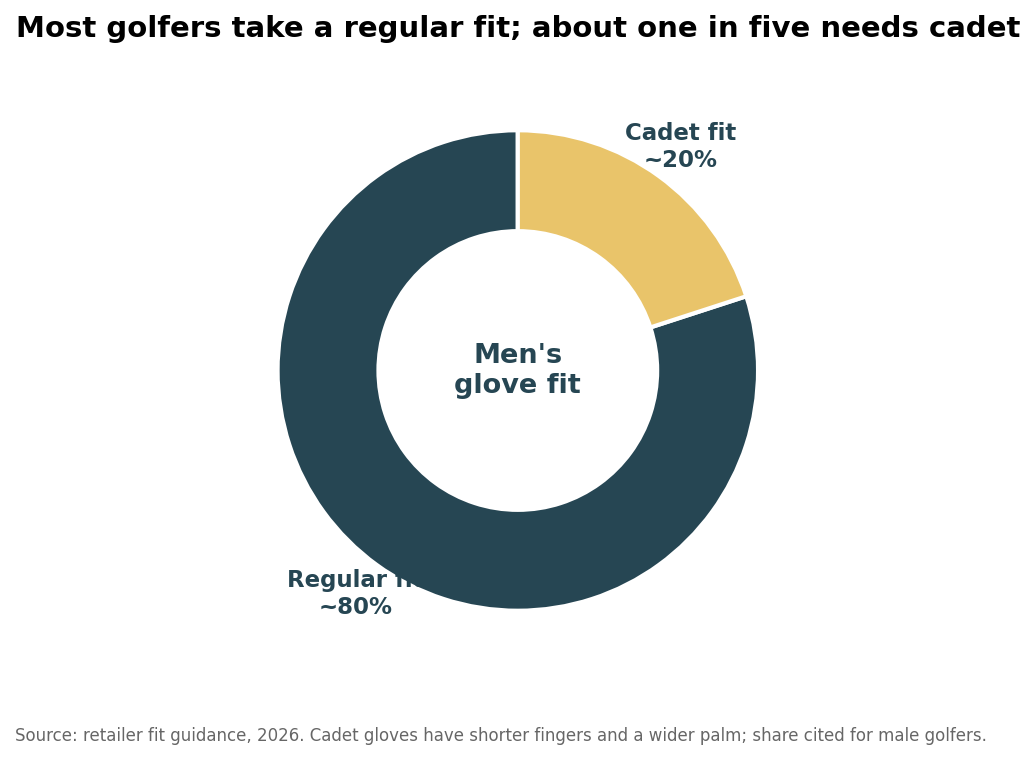
For a group order this matters practically. If you buy only regular sizes, a meaningful share of recipients will get a glove that fits poorly, and a poorly fitting glove is a wasted glove no matter how good the logo looks. Collect actual sizes where you can, and make cadet options available rather than assuming everyone runs standard. It is a small addition to a size grid that noticeably raises how many of your gloves actually get worn.
Personalizing without ruining the glove
Where and how you brand a glove is constrained by the fact that it is a flexible, high-wear item. The most reliable method is embroidery on the closure strap, the small tab that folds over the back of the hand; it is a stable surface, it holds a logo cleanly, and it is exactly where eyes land when a player addresses the ball. For bolder branding, an all-synthetic glove can be printed across the whole back panel by dye sublimation, letting you run team colors or a large mark that leather simply cannot carry the same way. Heat-applied transfers are another route for logos on synthetic surfaces.
The one rule that holds across every method is to keep decoration off the palm and fingers. That surface is doing the gripping, and printing or stitching there both wears away fastest and interferes with feel. Minimums and pricing vary widely by supplier, with some offering low or no minimums and promotional custom gloves often starting in the low twenties per glove as an indicative figure, and leather blanks costing more than synthetic ones. Put the pieces together in order: match the material to the conditions and budget, fit the glove to the actual hands, get the handedness right, and keep the logo on the strap or the back rather than the palm. Do that and you end up with gloves people wear rather than gloves people replace.