Roughly half of golfers play in a glove that does not fit, and the error almost always runs the same direction: too big. A loose glove slides at the top of the swing, bunches across the palm, and wears through at the heel in weeks instead of months. When you are buying a single glove that mistake is annoying. When you are ordering gloves for a team, a corporate outing, or a pro shop, the same mistake multiplies across every unit you buy. Getting the sizing right before the order goes in is the difference between a clean, professional set and a box of gloves half your group will not wear.
Measure the hand, not the glove
Golf glove sizing is driven by two hand measurements, and neither one is your regular apparel size. The first is hand circumference: wrap a soft tape around the widest part of your palm, just below the knuckles, with the thumb excluded. The second is middle finger length, taken from the base of the finger to the tip. Circumference sorts you into Small through X-Large; finger length is what decides whether you belong in a regular or a cadet cut, which the next section covers. If you only have a rigid ruler, measure the palm width across the knuckles and double it for a workable estimate, but a cloth tape around the hand is more reliable.
A correctly sized glove reads as a second skin. It should be snug across the palm with no wrinkling when you close your hand, the fingertips should reach the end of each finger stall with no empty material at the tips, and the closure tab should cover roughly three-quarters of the back of the hand, leaving about a quarter inch of gap for adjustment. If the tab wraps almost all the way to the far seam, the glove is too small; if there is loose fabric standing up at the fingertips or slack across the palm, it is too big. The most common failure is a golfer sizing up for comfort, then fighting a glove that never grips.
Reading the size chart
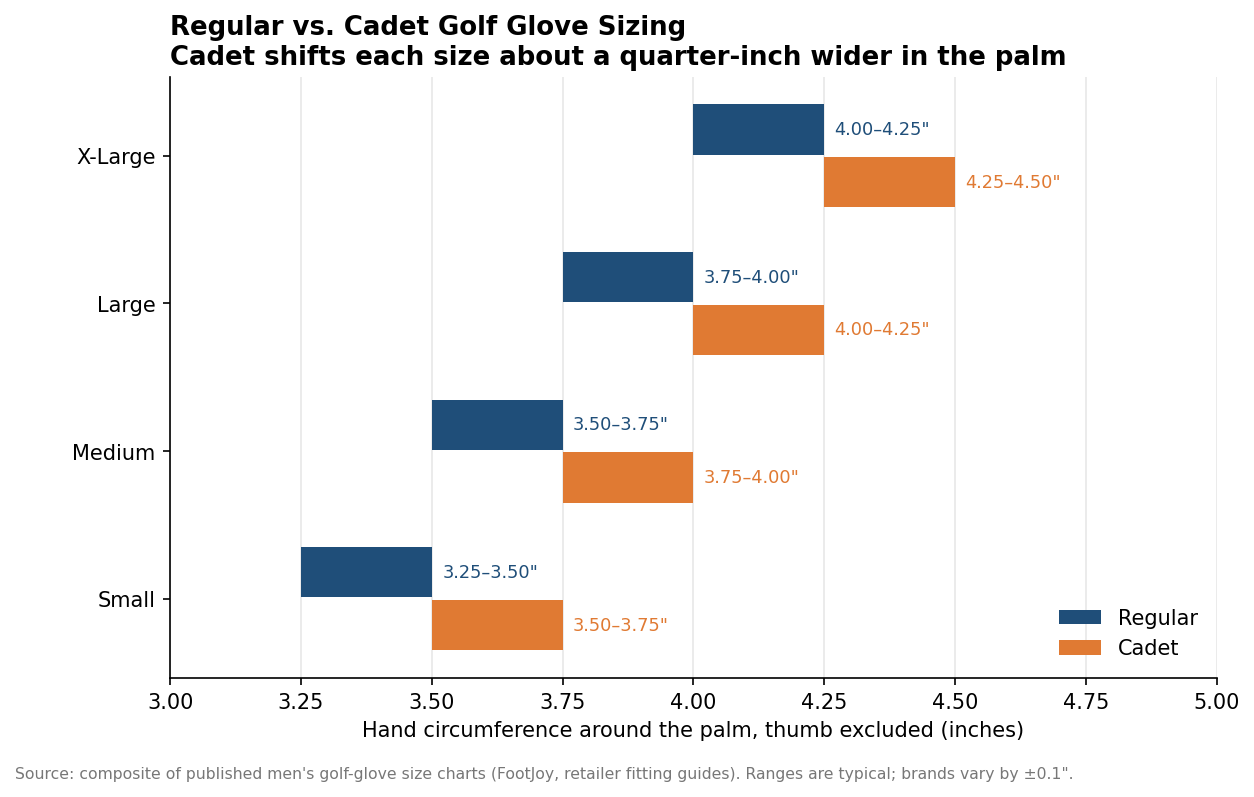
Men’s regular gloves map to palm circumference in quarter-inch bands: a Small covers roughly 3.25 to 3.5 inches, Medium 3.5 to 3.75, Large 3.75 to 4.0, and X-Large 4.0 to 4.25, with XX-Large continuing above that. Because those bands are narrow, a lot of hands land right on a seam between two sizes, which is why many brands offer a Medium-Large (ML) half-size. ML is not a marketing gimmick; it captures the large share of adult men who measure between a clean Medium and a clean Large, and it is usually the single most-ordered size in a mixed adult group. Women’s gloves run on their own scale, generally smaller and cut narrower through the palm, and youth sizes step down again, so a team order that spans men, women, and juniors needs all three charts open at once rather than one shared scale.
Brands vary by a tenth of an inch or so at each boundary, so treat any single chart as indicative rather than absolute. If you are ordering across an entire group from one supplier, size everyone against that supplier’s chart specifically instead of mixing measurements taken against different brands.
When cadet sizing solves the problem
Cadet gloves exist for a real anatomical mismatch: hands with wide palms and comparatively short fingers. On a regular glove, that hand fills the palm correctly but leaves empty material standing at the fingertips, the exact slack that causes slipping. A cadet cut keeps the same palm circumference while shortening every finger stall by about a quarter inch and widening the palm by a similar amount, so the fit tightens where a regular glove would gap. In practical terms a cadet Large runs wider in the palm and shorter in the fingers than a regular Large. Golfers with thick or stubby fingers, tradespeople and athletes whose hands are broad, and players whose fingers swell over a hot round are the typical candidates. The quick self-test is to try a regular glove in your palm size, close your fist around a club, and look at the fingertips: consistent empty material at the tops points you to cadet.
For a group order, expect a meaningful minority to need cadet cuts even though most will not. It is worth asking about finger fit specifically when you collect sizes, because someone who only reports “Large” may actually be a cadet Large and will be unhappy with a standard one.
Building a size run for a team or event
The single biggest lever on a bulk glove order is not the price per unit, it is guessing the size distribution correctly so you are not left with a stack of unworn Smalls and a shortage of Larges. The reliable method is to collect an actual measurement or a known glove size from every recipient before you order. When that is genuinely impossible, for example a tournament handing gloves to registrants you have never met, you fall back to a planning distribution weighted toward the middle of the range, then adjust for what you know about the group.
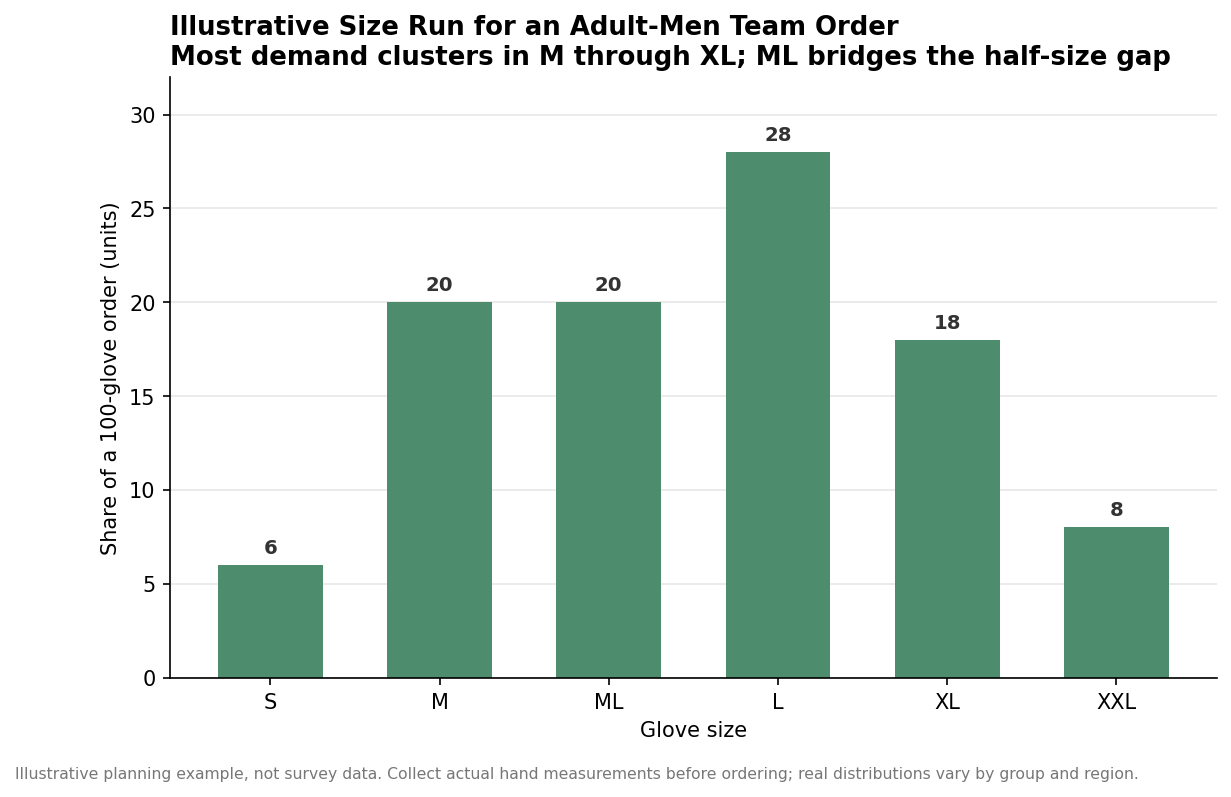
The illustrative run above shows why the middle sizes dominate an adult-men order and why carrying ML matters: a distribution that only stocks S, M, L, and XL forces every half-size hand into a compromise. Treat the exact percentages as a starting point, not a rule. A group of younger players skews larger, a mixed corporate field skews toward M and ML, and any field that includes women and juniors needs its own separate allocation rather than being folded into the men’s curve. Order a small buffer of the two or three most common sizes rather than spreading extras evenly, because that is where walk-up demand and swap-outs land.
Getting the fit right on delivery
Leather gloves, particularly cabretta, break in and relax slightly with the first few rounds, so a new leather glove should feel almost too snug out of the packet; if it is comfortable on day one it will be loose by week two. Synthetic and hybrid gloves stretch far less and should fit correctly from the first wear, which makes them the safer default for a group order where nobody is around to break anything in. If a recipient falls between sizes and you cannot offer a half-size, size down for leather and hold the true size for synthetic. Build a few minutes of fit-checking into any event handout, keep a handful of adjacent sizes on hand for swaps, and you will convert the order into gloves people actually wear instead of gloves that end up in a bag pocket.