Most golf glove advice assumes one glove, one climate, and a dry Saturday morning. Real play is messier. The same box of custom gloves might go out to a summer scramble, a rain-delayed member event, and a frost-on-the-cart-path winter round, and a glove that shines in one of those will quietly fail in another. Here is how to think about golf gloves by the conditions they actually meet, so you order for the weather your players see rather than the weather on the sample photo.
Start with the baseline: one glove, lead hand
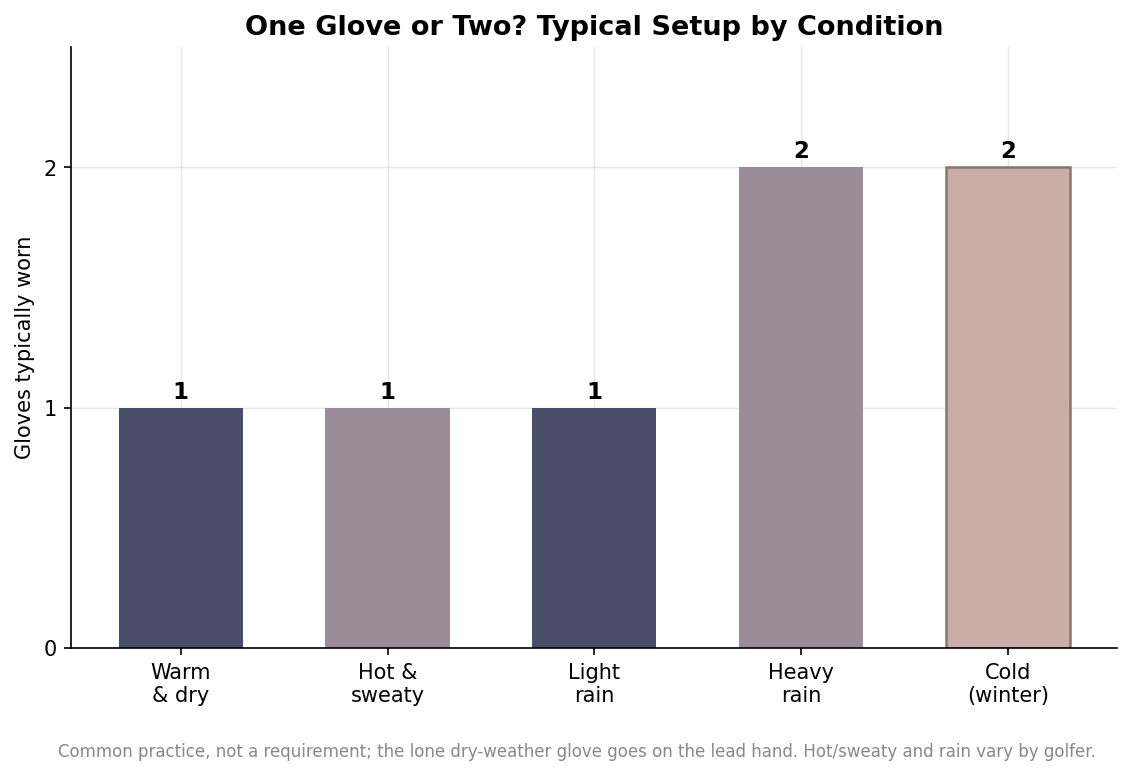
The default setup is a single glove on the lead hand, which is the left hand for a right-handed golfer and the right hand for a left-handed one. That hand does the most work through the swing, creating friction from takeaway to impact, so it is the one prone to blisters and wear. Most players leave the trail hand bare because skin directly on the rubber grip gives the best feel and feedback. Everything that follows is a departure from this baseline, and each departure is a response to a specific condition rather than a general upgrade.
Warm and dry: leather’s home turf
In warm, dry weather a premium Cabretta leather glove is hard to beat. Cabretta is a fine sheepskin, thinner and more supple than most leathers, and golfers prize it because it fits like a second skin and has a naturally tacky surface that grips the club well. It breathes, it feels precise on the driver, and with proper care a good pair can last several seasons. The catch is moisture. Cabretta is water resistant but not waterproof, so it is at its best when the air is warm and your hands stay reasonably dry. Push it into a humid afternoon where sweat soaks the palm and that same soft leather can start to feel slick and then stiffen as it dries. For players who sweat heavily, an all-weather synthetic or a second glove is often the more practical call even when it is not raining. A common trick in high heat is to rotate two gloves through the round, letting one air out on the bag while the other is in play, which keeps both drier and extends the life of each.
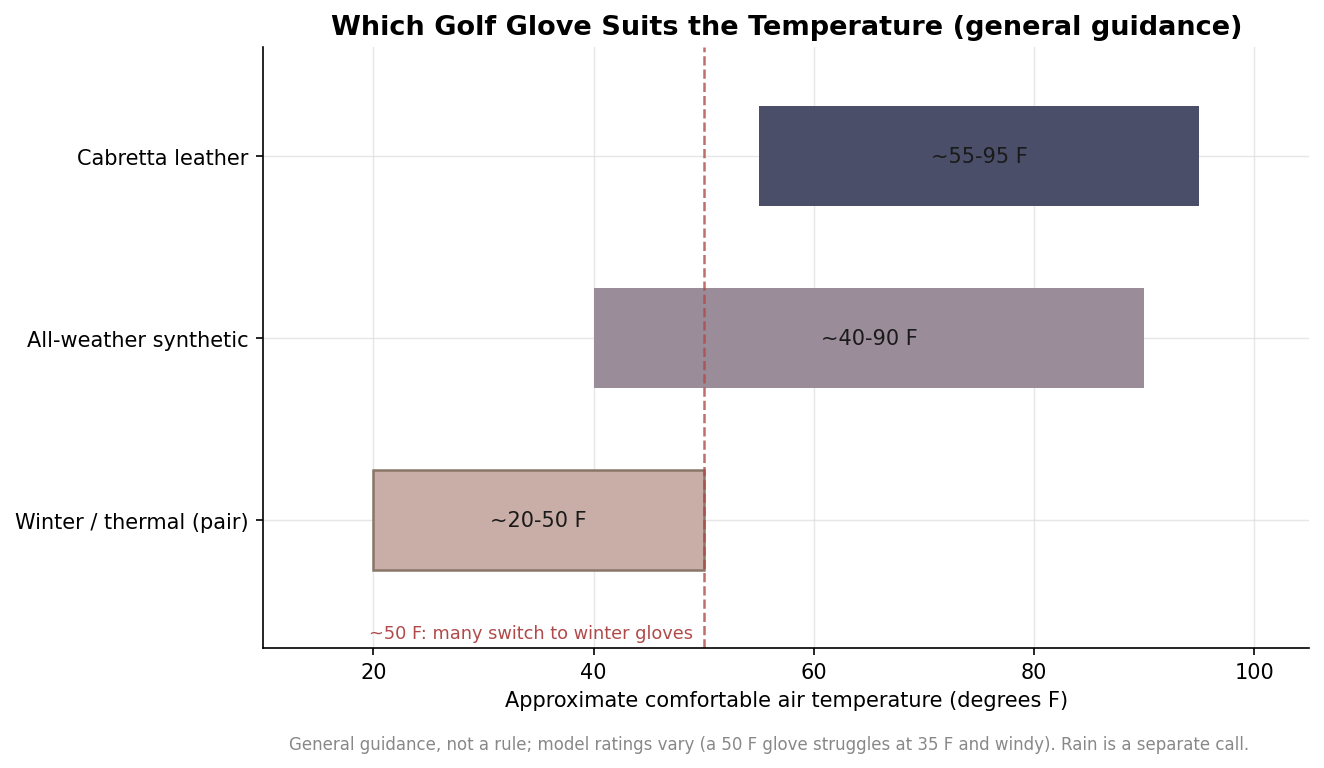
The chart above is general guidance, not a rulebook. Model ratings vary, and a glove built to feel good at fifty degrees will not do much for hands at thirty-five in a wind. Treat the bands as a starting point and let your players’ own tolerance move the line.
Rain: why one leather glove is the wrong tool
Rain is where glove selection matters most, because a wet grip is a lost grip. A single dry-weather leather glove is close to useless once it is truly soaked; it loses its tack and slides on the handle. The fix that tour players reach for is a pair of dedicated rain gloves worn on both hands. Rain gloves are built from synthetic materials, often with a four-way stretch shell and reinforced palm patches, and their surface actually grips better as it gets wetter rather than worse. Wearing two of them puts that wet-grip material on both hands, which is exactly what you want when the umbrella is up and the towel is already damp. Some players prefer a single waterproof glove instead, but for a scramble or an event likely to be rained on, budgeting for rain-glove pairs is the difference between finishing the round and giving up on the back nine.
Cold: winter gloves travel in pairs too
Cold weather flips the priority from grip feel to keeping the hands warm enough to have any feel at all. Winter golf gloves are designed to be worn as a pair on both hands, and they are built differently from summer gloves, using thermal linings such as fleece, Thinsulate, or synthetic insulation to trap heat while staying breathable enough to swing in. Many use treated or synthetic surfaces that handle damp cold better than untreated Cabretta. A common rough marker is around fifty degrees Fahrenheit, where a lot of golfers move from a standard single glove to a winter pair, though wind and personal cold tolerance shift that point a good deal. Some players also keep a pair of cart mitts or a hand warmer in the bag and only glove up for the shot itself, which keeps circulation going between holes.
Ordering for a group that plays in all of it
If you are buying custom gloves in bulk for a team, a tournament, or a corporate outing, the useful move is to match the order to the calendar rather than to a single default. A summer event skews toward breathable leather or a light all-weather synthetic in single-glove counts. An event with any rain risk should carry a share of rain-glove pairs, remembering that pairs mean two gloves per player, not one. A late-season or winter outing leans on insulated pairs and benefits from a few spares, since cold hands are hard on gloves and players lose them. It also pays to spread sizes sensibly across the group, including cadet sizes for players with shorter fingers and wider palms, because a glove that suits the weather still has to fit the hand to do its job. Because rain and winter setups double the glove count per person, plan those quantities before you price the job, or the shortfall shows up at the worst possible moment. Get the mix right and every player has the right glove for the day in front of them, which is the whole point of ordering ahead instead of hoping the weather cooperates.